
A congestion charge designed without a quantity cap
When Venice switched on its Contributo di Accesso on April 25, 2024—Italy’s Liberation Day holiday—it became the first major historic city in Europe to require day visitors to book a QR code and pay a municipal entry fee merely to walk its streets.1 Unlike national-park timed-entry permits or Maya Bay’s hourly quota, the Venetian ordinance sets no ceiling on the number of codes sold on any given morning. Every traveler willing to pay €5 in 2024, or €5 to €10 under the two-tier tariff introduced in 2025, receives admission.
That statutory choice defines what the instrument can and cannot accomplish. In standard urban transport economics, a pure price instrument reduces peak volume only if the fee is large relative to total trip expenditure or if close off-peak substitutes exist. For a family taking a regional train from Padua or Treviso, €10 per adult represents a noticeable surcharge on a €16 return rail fare—except that residents of the entire Veneto region are exempt from paying.2 For a day visitor arriving on a high-speed Frecciarossa from Milan, Rome, or Florence, where round-trip rail tickets and lunch routinely exceed €160 per person, a €5 advance voucher amounts to roughly 3 percent of day-trip outlay.
| Operating year | Charged days | Standard tariff | Advance discount | Paid vouchers issued | Gross receipts |
|---|---|---|---|---|---|
| 2024 (pilot) | 29 days (Apr 25–Jul 14) | €5 flat | None (€5 up to entry) | ~485,000 | €2.43 million |
| 2025 | 54 days (Apr 18–Jul 27) | €10 standard | €5 if booked 4+ days out | ~723,000 | €5.42 million |
| 2026 | 60 days (Apr 3–Jul 26) | €10 standard | €5 if booked 4+ days out | Full audit pending | Est. €5.8M–€6.3M |
Why exemptions dominate the denominator
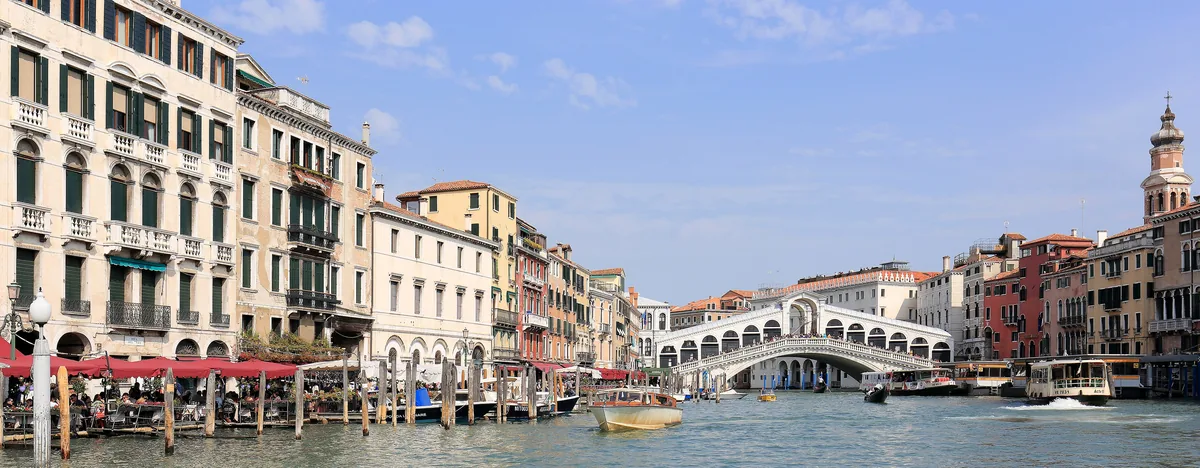
To understand why footfall on the Strada Nova and at the Rialto Bridge remained above pre-charge benchmarks on holiday weekends in both 2024 and 2025, one has to count who crosses the lagoon causeway without paying. Under City Council Deliberazione n. 51/2023 and its annual implementing schedules, overnight guests staying inside the municipality of Venice—whether in historic-center palazzi or mainland Mestre hotels—are exempt from the day fee because they already pay the municipal imposta di soggiorno (lodging tax).13 Also exempt are registered residents of Veneto (~4.85 million people), commuters, university students enrolled at Ca’ Foscari or IUAV, children under 14, hospital patients, and visitors arriving after 4:00 p.m.
Municipal portal logs from the 29 charged days of 2024 and the 54 charged days of 2025 reveal the arithmetic consequence. On busy Saturday peaks between late April and June, between 65,000 and 85,000 non-residents entered the historic islands during the 8:30 a.m.–4:00 p.m. charging window. Fewer than 15,000 to 25,000 of those entrants held paid €5 or €10 day vouchers; the remainder held free exemption QR codes—chiefly overnight lodging guests and Veneto residents—or belonged to categories exempt even from registration.3 Even if the €10 late-booking surcharge deterred 10 percent of out-of-region day-trippers, total pedestrian density along the San Marco–Rialto corridor would fall by less than 2 percent.
What the two-tier €5 / €10 tariff changed in 2025 and 2026
In 2025 the municipal executive doubled the base fee to €10 while preserving the €5 rate for visitors who booked at least four days before arrival, and expanded the calendar from 29 days to 54 (concentrated on Fridays, Saturdays, Sundays, and Italian spring holidays). For 2026, opening April 3, the calendar widened again to 60 days.4 Gross receipts more than doubled between 2024 (€2.43 million) and 2025 (€5.42 million), shifting the program from net operating deficit—early setup, portal development, and 140 stewards at Santa Lucia station and Piazzale Roma absorbed roughly €3 million in year one—into modest net surplus.3
The four-day advance discount produced a clear behavioral shift in booking timing, though not necessarily in travel volume. Municipal summaries from August 2025 reported that roughly three-fifths of paying visitors locked in the €5 advance tier, giving city transit operator ACTV and waste utility Veritas a four-day lead indicator of non-exempt day demand.3 What the data do not yet demonstrate is inter-day substitution—whether visitors moved trips from charged Fridays to uncharged Thursdays, or simply booked earlier for the same Saturday.
Enforcement friction and the counterfactual problem
Venice deliberately rejected physical turnstiles after street protests greeted metal crowd-control gates tested briefly in 2018. Instead, municipal stewards conduct spot QR checks at Piazzale Roma, Venezia Santa Lucia railway station, and key vaporetto landings, backed by administrative fines of €50 to €300.1 Spot-check enforcement preserves open streetscapes and avoids creating dangerous bottlenecks on narrow bridges, but it means observed QR counts measure compliance-weighted entries rather than true footfall.
Testing whether the Access Contribution dispersed crowds requires pairing portal registrations with an independent denominator—specifically, anonymized mobile-cell pings from Venice’s Smart Control Room at Tronchetto across matched spring weekends in 2023, 2024, 2025, and 2026, controlling for rainfall and regional rail strikes. Until the municipality releases disaggregated hourly cell-count series alongside portal logs, Venice’s experiment proves two narrower propositions: European courts and ministries will tolerate priced urban entry when residents and commuters are exempted, and a €5–€10 charge functions primarily as a fiscal cost-recovery instrument rather than a crowd-rationing gate.
Notes and primary sources
- 1
Comune di Venezia, Regolamento per l’istituzione e la disciplina del Contributo di accesso, con o senza vettore, alla Città antica del Comune di Venezia e alle altre isole minori della laguna (Deliberazione del Consiglio Comunale n. 51, September 12, 2023); The Guardian, “‘Recipe for disaster’: Venice entry fee sparks confusion and protest on day one,” April 25, 2024.
- 2
Under the Veneto resident exemption (cda.ve.it), individuals whose registered municipal residence (residenza anagrafica) lies anywhere in the Region of Veneto owe €0, though during the 2024–2026 calendars they were required to hold an exemption code or show regional ID on inspection.
- 3
Comune di Venezia, “Ventinovesima giornata del contributo di accesso a Venezia,” July 14, 2024 (reporting ~485,000 paying visitors and €2.425 million in 2024); Comune di Venezia, “Contributo di accesso: i numeri del 2025,” August 4, 2025 (reporting ~723,000 paid vouchers and €5.42 million across 54 days).
- 4
Comune di Venezia, “Venezia: oggi apre il portale per il Contributo di accesso 2026. Confermata quota da 5 a 10 euro. Avvio dal 3 aprile,” March 2, 2026; The Guardian, “Venice’s €5 tourist fee returns – and will double for last-minute day-trippers,” April 17, 2025.
Cite this publication
Meridian Tourism Research Institute. 2026. “Venice’s Access Contribution at Three Seasons: Day-Tripper Pricing, Exemptions, and Turnstile Counts (2024–2026).” Meridian Working Paper WP 2026-01, October 28, 2026. https://meridiantourismri.org/articles/venice-access-fee-three-seasons.html.
@techreport{mtri_wp_2026_01,
  author      = {Meridian Tourism Research Institute},
  title       = {Venice’s Access Contribution at Three Seasons: Day-Tripper Pricing, Exemptions, and Turnstile Counts (2024–2026)},
  institution = {Meridian Tourism Research Institute},
  type        = {Working Paper},
  number      = {WP 2026-01},
  address     = {New York, NY},
  year        = {2026},
  month       = {October},
  url         = {https://meridiantourismri.org/articles/venice-access-fee-three-seasons.html}
}