
Why ports choose negotiated agreements in the United States and public-law caps in Europe
In June 2024 the City and Borough of Juneau—a capital of 31,500 residents that hosted 1.67 million cruise passengers in 2023—signed a voluntary Memorandum of Agreement with major cruise lines capping daily capacity at 16,000 lower berths from Sunday through Friday and 12,000 on Saturdays starting in the 2026 season.1 Three weeks later, on June 27, 2024, Amsterdam announced it would halve annual sea-cruise calls at Passenger Terminal Amsterdam (PTA) from 190 to 100 by 2026, followed in January 2026 by an executive proposal to end central sea-cruise berthing altogether from 2035 rather than spend an estimated €85 million moving the terminal westward to Coenhaven.2
The legal divergence is structural. U.S. coastal towns operate in the shadow of federal maritime preemption, the Tonnage Clause, and state legislative overrides: when Key West voters approved ship-size limits in 2020, Florida’s legislature voided them, and when Bar Harbor, Maine enacted a 1,000-passenger daily disembarkation cap at private piers, maritime businesses tied the town up in multi-year federal appeals.3 Negotiated MOAs like Juneau’s avoid courtroom injunctions, at the price of relying on industry consent and counting 'lower berths' (two passengers per cabin) rather than actual manifest headcounts, which run higher during July family school holidays.
| Port / Jurisdiction | Instrument design | Statutory metric | Legal basis | Primary distortion or trade-off |
|---|---|---|---|---|
| Juneau, Alaska | Daily passenger ceiling | 16,000 lower berths Sun–Fri; 12,000 Sat (5-ship cap) | Voluntary CBJ–CLIA MOA (June 2024) | Lower-berth count omits 3rd/4th upper-bunk family occupancy (+12–18% peak summer) |
| Amsterdam | Annual vessel-call cap | 100 sea-cruise calls/yr at central PTA (down from 190) | Municipal port allocation (June 2024) | Incentivizes lines to deploy larger vessels per slot, trimming calls faster than passengers |
| Dubrovnik | Simultaneous berthing cap | Max 2 cruise ships (~4,000–5,000 pax) at once | Port Gruž slot schedule & 2024 Tourism Act | Flattens 10 a.m.–2 p.m. Old Town spikes without cutting total seasonal volume |
| Santorini & Mykonos | Seasonal disembarkation fee | €20 Jun–Sept; €12 shoulder; €4 winter (other ports €5/€3/€1) | Greek Law 5162/2024, Art. 27 (from July 21, 2025) | Raises municipal water/port revenue; €20 rarely alters pre-booked Mediterranean itineraries |
Call caps vs. berth caps: the vessel-upgauging effect
Capping the number of ships that dock in a year is simpler to administer than auditing passenger manifests, yet it invites upgauging. Across global cruise orderbooks delivered between 2022 and 2026, average vessel capacity exceeded 4,200 lower berths, compared with ~2,100 on vessels retired after 2020. When a port cuts annual calls by 47 percent—as Amsterdam did in moving from 190 calls to 100—cruise operators naturally assign scarce central-harbor slots to higher-capacity vessels unless length, draft, or canal-lock dimensions (specifically the IJmuiden sea locks) bind.
Simultaneous-berth scheduling, pioneered in Dubrovnik’s Port Gruž since 2019 and reinforced in Palma de Mallorca’s three-ship agreement, targets a narrower physical bottleneck: the hourly flow of excursion buses through a medieval city gate or cable-car queue.4 Smoothing arrivals from five ships on Tuesday and zero on Wednesday to two ships each day substantially lowers peak pedestrian congestion without necessarily reducing annual port revenues.
Greece’s Law 5162/2024 and itinerary displacement in the Aegean
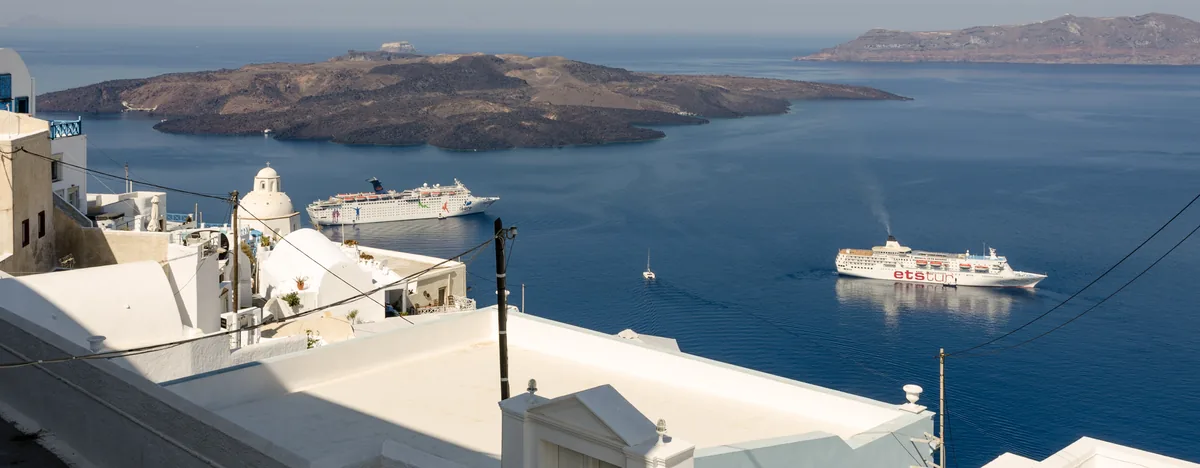
Greece took the pricing route instead. Under Article 27 of Law 5162/2024, implemented by Ministry of Maritime Affairs circular on July 21, 2025, every cruise passenger stepping ashore pays €20 at Santorini and Mykonos from June through September (€12 in April, May, and October; €4 in winter), while all other Greek ports charge €5 in summer, €3 in shoulder months, and €1 in winter.5 Half of Santorini’s receipts are earmarked to local municipal infrastructure—including desalination and cable-car upgrades—and half to port and tourism ministries.
That €15 summer price differential between Santorini/Mykonos (€20) and secondary islands such as Syros, Milos, Chania, or Rhodes (€5) sets up a clean empirical test for 2026–2028 cruise schedules: for a 4,000-passenger ship, substituting one Cycladic port saves €60,000 in port fees per call, though passengers book Aegean itineraries specifically expecting Santorini’s caldera. Pairing port-authority call logs with shore-merchant card-spend data will show whether €20 shifts itineraries or functions purely as a fiscal transfer from cruise lines and passengers to island utilities.
Notes and primary sources
- 1
City and Borough of Juneau, “City and Borough of Juneau and cruise lines sign Memorandum of Agreement on port capacity,” June 3, 2024; Associated Press, “New agreement would limit cruise passengers in Juneau. A critic says it doesn’t go far enough,” June 5, 2024; Juneau Empire, “Juneau’s 1st cruise ship of 2026 set to dock on April 27,” April 23, 2026.
- 2
City of Amsterdam, “Amsterdam halveert aantal zeecruiseschepen en wil vertrek cruiseterminal uit centrum in 2035,” June 27, 2024; NOS, June 27, 2024; AT5 and NL Times, January 2026 (reporting the €85 million Coenhaven relocation estimate and executive proposal to end sea cruises from 2035).
- 3
Association to Preserve and Protect Local Livelihoods et al. v. Town of Bar Harbor, U.S. Court of Appeals for the First Circuit (2025), reviewing Town of Bar Harbor Land Use Ordinance § 125-77H.
- 4
City of Dubrovnik and CLIA Memorandum of Understanding ('Respect the City,' 2019); Croatian Tourism Act (Zakon o turizmu, Narodne novine 156/2023, effective January 1, 2024).
- 5
Hellenic Republic, Law 5162/2024, Article 27, Government Gazette A' 198, December 5, 2024; Ministry of Maritime Affairs and Insular Policy Circular 3133.4-1/53018/18-07-2025, July 18, 2025; Santorini simultaneously maintains an administrative ceiling of ~8,000 daily cruise visitors tied to cable-car berth allocations.
Cite this publication
Meridian Tourism Research Institute. 2026. “Berth Caps, Call Caps, and Per-Passenger Port Fees: Comparing Juneau, Amsterdam, Dubrovnik, and the Greek Islands.” Meridian Working Paper WP 2026-04, September 30, 2026. https://meridiantourismri.org/articles/cruise-berth-caps-juneau-amsterdam-greece.html.
@techreport{mtri_wp_2026_04,
  author      = {Meridian Tourism Research Institute},
  title       = {Berth Caps, Call Caps, and Per-Passenger Port Fees: Comparing Juneau, Amsterdam, Dubrovnik, and the Greek Islands},
  institution = {Meridian Tourism Research Institute},
  type        = {Working Paper},
  number      = {WP 2026-04},
  address     = {New York, NY},
  year        = {2026},
  month       = {September},
  url         = {https://meridiantourismri.org/articles/cruise-berth-caps-juneau-amsterdam-greece.html}
}