

Why static tax tables cannot answer the fiscal question facing city councils
Whenever a U.S. municipality debates restricting short-term rentals in single-family neighborhoods—as Corpus Christi’s City Council is scheduled to decide on December 15, 2026 after extending its permit moratorium on November 17—two competing claims dominate public hearings.1 Property-rights advocates warn that barring whole-home vacation rentals will hollow out municipal Hotel Occupancy Tax (HOT) collections that finance convention centers, destination marketing, and coastal beach maintenance. Neighborhood coalitions counter that displaced visitors simply rebook into taxed hotels and multifamily properties.
Static statutory rate tables cannot resolve that debate because the net fiscal outcome turns on substitution elasticity: what fraction of displaced residential STR room nights shifts into taxable local hotels rather than leaving the jurisdiction altogether. To test that mechanism with primary treasury data rather than industry estimates, we assembled a four-year audited municipal panel directly from the Texas Comptroller of Public Accounts’ statutory Local HOT Reporting filings for FY2022 through FY2025 (Socrata datasets 9xry-ncut, qik7-ypfg, ifh4-9tpn, and er34-v24h).2
| Municipality | STR Regulatory Posture | Ch. 351 Rate | FY2022 ($) | FY2024 ($) | FY2025 ($) | 3-Yr Growth | FY25 Unspent / Rev |
|---|---|---|---|---|---|---|---|
| Corpus Christi | Coastal (Dec 15, 2026 SFH Vote) | 7% | $14,925,843 | $14,549,515 | $20,047,076 | +34.3% | 9% ($1.82M) |
| Galveston | Coastal (Open STR Reg.) | 9% | $29,633,424 | $27,023,237 | $26,863,679 | -9.3% | 69% ($18.65M) |
| South Padre Island | Coastal (Open STR Reg.) | 9% | n/r | $11,448,411 | $12,831,425 | n/r (+12.1% YoY) | 238% ($30.53M) |
| Grapevine | SFH STR Ban (Ord. 2018-065) | 7% | $20,810,261 | $24,555,416 | $23,512,534 | +13.0% | 0% reported |
| Plano | SFH STR Ban (Enacted 2023) | 7% | $10,889,103 | $12,895,296 | $13,342,764 | +22.5% | 0% reported |
| Fort Worth | SFH STR Ban (+2% Prop A) | 9% | $27,830,630 | $46,710,911 | $46,521,984 | +67.2% | 0% reported |
| Austin | Type-2 STR Cap | 9% | $110,270,284 | $133,357,408 | $132,150,027 | +19.8% | 0% reported |
| San Antonio | 12.5% Block-Face Cap | 9% | $93,029,671 | $99,324,451 | $104,769,601 | +12.6% | 14% ($14.24M) |
| Houston | Unrestricted -> 2026 Reg. | 7% | $82,504,870 | $106,334,352 | $111,191,706 | +34.8% | 0% reported |
| Irving | DFW Convention Hub | 7% | $20,723,322 | $24,874,046 | $27,278,250 | +31.6% | 3% ($0.72M) |
| Fredericksburg | Hill Country STR Cap | 7% | $5,788,519 | $5,884,567 | $5,873,164 | +1.5% | 48% ($2.79M) |
| El Paso | Border Convention Hub | 7% | $13,723,954 | $15,634,702 | $14,570,760 | +6.2% | 209% ($30.48M) |
Data construction and a forensic Texas Comptroller schema finding
Under Texas Tax Code Section 351.009, municipalities levying a local HOT must report annual statutory tax rates, Chapter 351 municipal collections, Chapter 334 venue collections, spending allocations by statutory category, and unspent year-end reserve balances to the Comptroller. Filtering strictly to municipal filings (excluding overlapping county HOT filings that share city names, such as Houston County and El Paso County) yields 435 reporting Texas cities in FY2025 collecting $953.88 million in Chapter 351 HOT and $101.73 million in Chapter 334 venue taxes ($1.056 billion combined). Across all four consecutive fiscal years, 261 municipalities form a balanced panel whose aggregate Chapter 351 collections grew 23.33 percent from $590.05 million in FY2022 to $727.73 million in FY2025 (+3.70 percent year over year in FY2025).
Raw state treasury files require forensic cleaning before running regressions. In the Comptroller’s FY2023 release (qik7-ypfg), an eight-digit form ceiling truncated Houston’s reported Chapter 351 total at exactly $99,999,999.99 even though FY2022 ($82.50 million), FY2024 ($106.33 million), and FY2025 ($111.19 million) confirm Houston crossed $100 million cleanly. Similarly, FY2023 column schemas renamed totalrevenue351 to totalrevenue and mixed percentage strings with decimal fractions. Our open 261-city replication CSV standardizes every municipal entity across all four years and isolates Chapter 351 base receipts from Chapter 334 venue surcharges.3
Single-family STR bans in DFW suburbs vs. multi-bedroom coastal leisure markets
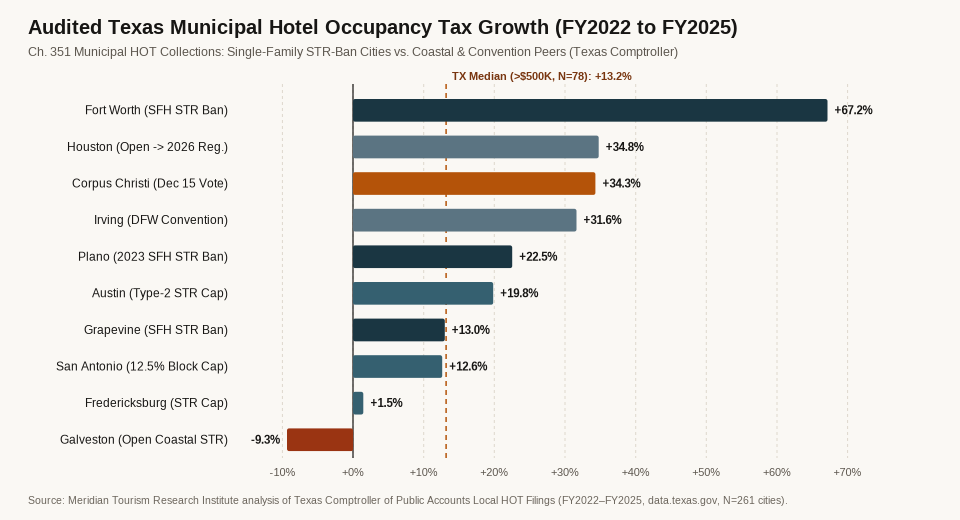
Among the 78 balanced-panel Texas cities collecting at least $500,000 in FY2022, median three-year Chapter 351 HOT growth from FY2022 to FY2025 was +13.17 percent (interquartile range: -0.80 percent to +31.63 percent). Crucially, inland Dallas-Fort Worth municipalities enforcing strict single-family residential STR bans matched or outperformed that statewide median. Plano—which banned new single-family STRs in 2023 while imposing $1 million liability insurance and registration rules on grandfathered units—grew Ch. 351 collections every consecutive year from $10.89 million (FY2022) to $13.34 million (FY2025), a +22.5 percent three-year gain (+3.5 percent YoY). Grapevine, whose single-family prohibition (Ord. 2018-065) was litigated to the Texas Supreme Court in City of Grapevine v. Muns, expanded +13.0 percent over the same three-year span ($20.81 million to $23.51 million). Fort Worth rose +67.2 percent ($27.83 million to $46.52 million), reflecting both its February 2023 two-point Proposition A rate increase (7% to 9%) and roughly 30 percent underlying lodging-base expansion.
Policy transfer from DFW suburbs to Gulf Coast municipalities, however, carries a critical structural caveat. Business, corporate-transient, and convention-center demand in Plano, Grapevine, and Irving shifts smoothly into full-service hotels when residential STRs are restricted. Coastal family leisure destinations operate under a different product mix: multi-bedroom beach homes on Padre Island, Galveston Island, and South Padre Island are imperfect substitutes for standard double-queen hotel rooms. Corpus Christi enters its December 15, 2026 vote from a position of strong recent momentum—Ch. 351 collections jumped +34.3 percent from FY2022 ($14.93 million) to FY2025 ($20.05 million), sharply outperforming open coastal peer Galveston (-9.3 percent from its FY2022 post-pandemic surge, $29.63 million to $26.86 million). If a coastal council prohibits single-family STRs without preserving designated island or resort overlays, displaced multi-family beach groups face lower local hotel recapture rates and higher leakage toward neighboring unrestricted coastal towns such as Port Aransas or Rockport.
The $510 million unspent reserve paradox and municipal budget implications
A second finding hidden inside the FY2025 Comptroller filings directly affects bond coverage and coastal infrastructure planning. Across 370 reporting Texas municipalities that disclosed non-zero year-end balances, cities held $510.07 million in unspent Chapter 351 HOT reserves at the close of FY2025. Several high-tourism jurisdictions hold more than a full year of unallocated collections: South Padre Island reported $30.53 million in unspent HOT balances against $12.83 million in annual FY2025 Ch. 351 receipts (238 percent reserve ratio), El Paso held 209 percent, Rockport held 155 percent, Waco held 149 percent, and Galveston held $18.65 million (69 percent). Corpus Christi, by contrast, deployed almost all of its FY2025 inflow (reporting $1.82 million in current-year unspent funds, or 9 percent of collections, with 62.2 percent directed to destination advertising).
For municipal CFOs, city attorneys, and bond analysts evaluating STR zoning reforms in 2026–2027, the combined takeaway is operational rather than ideological: audited Texas treasury data show that single-family STR restrictions have not collapsed hotel-tax revenues in hotel-dense metropolitan economies, but coastal municipalities with lean reserve cushions and high beach-house demand shares should model parcel-level STR remittance exposure separately from hotel ADR before enacting blanket single-family prohibitions.4
Notes and primary sources
- 1
City of Corpus Christi City Council Agenda & STR Moratorium Extension (Nov. 17, 2026; rescheduled final vote Dec. 15, 2026); Corpus Christi Code Ch. 13 Art. V & CorpusChristiTX.gov (9% City/Venue HOT + 6% TX State HOT).
- 2
Texas Comptroller of Public Accounts, Local Hotel Occupancy Tax Reporting Open Datasets (FY2022: 9xry-ncut; FY2023: qik7-ypfg; FY2024: ifh4-9tpn; FY2025: er34-v24h), Texas Open Data Portal (data.texas.gov), accessed November 23, 2026.
- 3
Meridian Tourism Research Institute, Audited 261-City Balanced Texas Municipal HOT Replication Panel (FY2022–FY2025, CSV), open access under CC BY 4.0 at https://meridiantourismri.org/assets/data/tx_comptroller_hot_panel_fy2022_fy2025.csv.
- 4
Texas Tax Code Ch. 351 (§ 351.009 municipal reporting) & Tex. Loc. Gov. Code Ch. 334 (venue taxes); City of Grapevine v. Muns (Tex. Sup. Ct.); City of Plano STR Ordinance (2023).
Cite this publication
Saechueng, Chaiwat, and Mukesh Thakur. 2026. “Do Single-Family Short-Term Rental Bans Shrink Municipal Hotel Tax Bases? Audited Panel Evidence from 261 Texas Cities (FY2022–FY2025).” Meridian Working Paper WP 2026-33, November 23, 2026. https://doi.org/10.5281/zenodo.24488490.
@techreport{mtri_wp_2026_33,
  author      = {Saechueng, Chaiwat and Thakur, Mukesh},
  title       = {Do Single-Family Short-Term Rental Bans Shrink Municipal Hotel Tax Bases? Audited Panel Evidence from 261 Texas Cities (FY2022–FY2025)},
  institution = {Meridian Tourism Research Institute},
  type        = {Working Paper},
  number      = {WP 2026-33},
  address     = {New York, NY},
  year        = {2026},
  month       = {November},
  doi         = {10.5281/zenodo.24488490},
  url         = {https://meridiantourismri.org/articles/texas-str-bans-audited-hot-panel-fy2022-fy2025.html}
}