

Benchmarking Oregon’s January 1, 2027 HB 4134 Nature Conservation Fee with 22.5 years of DOR returns
On January 1, 2027, Oregon House Bill 4134 (2026) makes Oregon the second U.S. state after Hawaii (Act 96) to enact a dedicated statewide environmental surcharge on overnight lodging, raising the Oregon State Transient Lodging Tax (ORS 320.305) by 1.25 percentage points from 1.50 percent to 2.75 percent and requiring guest receipts to label the increase a “nature conservation fee.” Proceeds fund the Oregon Department of Fish and Wildlife (State Wildlife Action Plan and Recovering Oregon’s Wildlife Fund), the Oregon Conservation Corps, wildlife law enforcement, and wolf coexistence grants. Crucially, unlike Hawaii’s cash-basis transition under DOTAX Announcement No. 2025-03—which induced a +4.57 percentage-point December 2025 advance-booking pull-forward documented in Meridian Working Paper WP 2026-35—Oregon DOR promulgated OAR 150-320-0042 applying the 2.75 percent rate strictly to lodging nights beginning on or after January 1, 2027.1
To establish an audited pre-launch empirical baseline, we extracted all 90 consecutive quarters of Oregon Department of Revenue State Transient Lodging Tax return statistics spanning 2004 Q1 through 2026 Q2 (FY 2004–FY 2026; $41.17 billion in cumulative taxable lodging sales across 7 accommodation filer categories in dataset 8prr-d4xq and 10 tourism regions in dataset mf7n-egve, refreshed October 16, 2026 and reconciling to $0.00 million horizontally across both series).2
| Accommodation Filer Type | FY 2019 | FY 2025 | FY 2026 | FY26 Share | FY26 YoY | FY19→26 | 2027 5% Fee |
|---|---|---|---|---|---|---|---|
| Direct Hotels | $1,350.0M | $1,441.4M | $1,454.9M | 47.97% | +0.94% | +7.8% | $2,000.5k |
| Online Intermediaries (~30 filers) | $441.7M | $815.5M | $908.2M | 29.94% | +11.37% | +105.6% | $1,248.8k |
| Direct Motels | $275.7M | $297.3M | $282.8M | 9.32% | -4.88% | +2.6% | $388.8k |
| Direct Vacation Homes (505 filers) | $128.4M | $245.6M | $230.4M | 7.60% | -6.19% | +79.4% | $316.8k |
| Campgrounds / RV Sites | $86.7M | $114.2M | $122.5M | 4.04% | +7.29% | +41.3% | $168.4k |
| Bed & Breakfast / Other | $121.7M | $31.7M | $34.3M | 1.13% | +8.22% | -71.8% | $47.1k |
| Statewide Total (100%) | $2,404.3M | $2,945.6M | $3,033.1M | 100.00% | +2.97% | +26.2% | $4,170.5k |
The 30% online platform takeover and the uncapped 5% collector retention windfall
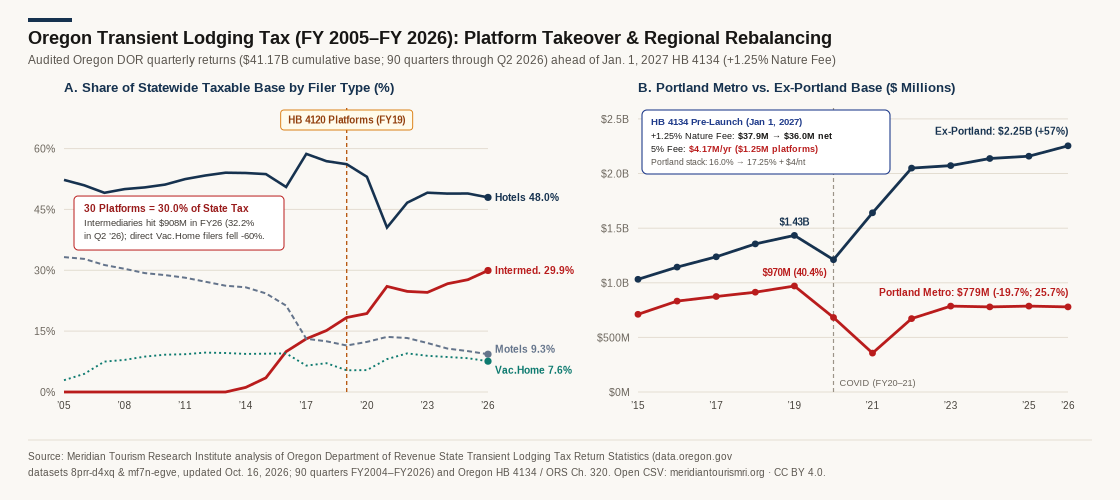
Oregon’s 22-year tax-return archive provides the longest audited administrative proof in the United States of how online booking intermediaries reshaped lodging tax remittance. Prior to FY 2014, online intermediaries remitted 0.0 percent of Oregon state TLT. Following early platform agreements and Oregon’s HB 4120 (2018)—which legally defined online travel companies and short-term rental platforms as lodging intermediaries obligated to collect state and local TLT—intermediary remittances expanded from 10.0 percent in FY 2016 ($198 million) to 18.4 percent in FY 2019 ($441.7 million), 26.0 percent in FY 2021, and 29.94 percent ($908.2 million) in FY 2026, setting an all-time quarterly high of 32.2 percent ($270.6 million) in Q2 2026 (April–June 2026). In FY 2026 alone, intermediary sales surged +11.37 percent (+$92.76 million)—accounting for 106 percent of Oregon’s entire statewide FY 2026 base gain (+$87.48 million, +2.97 percent) while direct Hotels grew +0.94 percent, direct Motels fell -4.88 percent, and direct Vacation Homes dropped -6.19 percent. Simultaneously, direct Vacation Home tax filers declined 60 percent from 1,260 per quarter in FY 2018 to 505 per quarter in FY 2026 as compliance consolidated into roughly 30 online intermediaries.
That concentration exposes a costly statutory artifact inside ORS 320.305(3)(b) and ORS 320.345, which allow every collector to withhold 5.0 percent of collected state (and generally local) lodging taxes as an administrative reimbursement. Across all 90 quarters, net state liability has equaled exactly 95.00 percent of gross tax—costing Oregon $28.16 million cumulatively ($2.275 million in FY 2026). Because HB 4134 raises the state rate +83 percent without capping the 5 percent vendor discount, state collector retention will mechanically jump to $4.170 million per year on the FY 2026 base—reducing HB 4134’s baseline $37.91 million gross Nature Conservation Fee by $1.896 million to $36.02 million net, and transferring $1.249 million per year in state tax retention directly to ~30 automated booking platforms (before counting local 5 percent discounts across Oregon’s 6 to 11.5 percent city and county TLT rates).3
Portland Metro’s permanent -14.7 percentage-point contraction vs. coastal and central growth
Regional filings across all 10 Oregon tourism regions reveal a stark structural divide heading into January 1, 2027. In FY 2019, Portland Metro generated 40.4 percent ($970.5 million) of Oregon’s statewide lodging base—exceeding Central Oregon (10.3 percent) and the North and Central Coasts (18.4 percent) combined. Six fiscal years later, Portland Metro has still not regained its nominal FY 2019 sales: FY 2026 taxable sales totaled $779.1 million (-19.7 percent below FY 2019 nominally, and roughly -36 percent in real CPI-adjusted dollars), sliding further to 25.7 percent of the state total after contracting -0.97 percent YoY in FY 2026. By contrast, Oregon’s nine non-Portland regions expanded +57.2 percent (+$820.2 million) above FY 2019 to $2.254 billion (74.3 percent statewide share; +4.40 percent YoY in FY 2026), led by Central Coast (+66.5 percent), Central Oregon/Bend (+63.0 percent), North Coast (+58.4 percent; +10.83 percent YoY in FY 2026), South Coast (+74.0 percent), and Willamette Valley (+55.8 percent).
This geographic rebalancing carries two concrete fiscal consequences as HB 4134 lifts Portland’s combined checkout tax stack from 16.0 percent to 17.25 percent (plus the $4.00/night STR affordable-housing fee). First, Portland enters a higher tax bracket with soft urban convention demand, whereas Bend (11.9 percent to 13.15 percent) and Seaside (11.5 percent to 12.75 percent) enter from expanding leisure demand. Second, rotating Oregon’s tax base away from year-round urban hotels (Portland Q3 summer / Q1 winter ratio = 1.66x) toward coastal and mountain leisure markets (Central Oregon 3.60x, North Coast 3.37x, Vacation Homes 3.90x) makes Oregon’s state TLT—and ODFW’s new wildlife conservation stream—significantly more summer-concentrated and exposed to Pacific Northwest wildfire smoke.4
Historical HB 4146 rate-shock benchmark and three pre-launch governance checks
Oregon’s last statutory state rate increase—HB 4146, which lifted the state TLT +0.80 percentage points from 1.00 percent to 1.80 percent on July 1, 2016—offers a direct in-state empirical benchmark. Estimating a region-fixed-effects panel regression of quarterly YoY log taxable sales growth across all 10 regions over the 16 quarters surrounding the increase (FY 2015–FY 2018; N = 160 region-quarters) shows mean YoY growth moderated from +12.24 percent pre-hike to +6.81 percent post-hike (beta = -5.43 pp, quarter-clustered SE = 1.39 pp, t = -3.91). Even with that post-peak moderation, statewide taxable sales grew +6.9 percent in FY 2017 and +7.5 percent in FY 2018, expanding net state TLT collections +92.4 percent ($18.77 million to $36.11 million) in Year 1.
Ahead of January 1, 2027, three operational checks stand out for Oregon policymakers and revenue analysts: (1) evaluate capping or tiering ORS 320.305’s 5 percent collector allowance for high-volume automated online platforms so $1.25 million/year in state retention (and millions locally) does not leak out of wildlife conservation; (2) preserve quarter-segmented rate accounting across FY 2027 cumulative reports (1.50 percent in Q1–Q2 FY27 vs. 2.75 percent in Q3–Q4 FY27) to prevent the $29.51 million retroactive formula bug we documented in Hawaii DOTAX’s FY 2026 cumulative TAT series; and (3) stress-test Portland and Multnomah County hotel occupancy and visitor-facilities bond coverage at the new 17.25 percent stack given Portland Metro’s persistent -19.7 percent nominal gap below FY 2019. The complete 1,530-row audited replication CSV is openly archived under CC BY 4.0.5
Notes and primary sources
- 1
Oregon Legislative Assembly, House Bill 4134 (2026 Regular Session; raising state TLT from 1.50% to 2.75% eff. Jan. 1, 2027 with 1.25% “nature conservation fee” receipt disclosure); Oregon Administrative Rule OAR 150-320-0042 (night-of-occupancy split rule).
- 2
Oregon Department of Revenue, State Transient Lodging Tax Return Statistics by Accommodation Type (dataset 8prr-d4xq, 630 rows) and by Region (dataset mf7n-egve, 900 rows), data.oregon.gov, updated October 16, 2026 (accessed November 24, 2026).
- 3
Oregon Revised Statutes Ch. 320: ORS 320.305 (State TLT & 5% collector reimbursement charge), ORS 320.345 (local 5% reimbursement floor), and Oregon HB 4120 (2018; transient lodging intermediary collection mandate).
- 4
City of Portland Code Ch. 6.04 (6.0% City TLT + $4.00/nt STR Housing Fee), Multnomah County 5.5% TLT, and 3.0% Portland TID; City of Bend Code Ch. 7.16 (10.4% TRT); Meridian Working Paper WP 2026-35 (Hawaii Act 96 Audit, https://doi.org/10.5281/zenodo.24505268).
- 5
Meridian Tourism Research Institute, 90-Quarter Audited Oregon DOR Transient Lodging Tax Replication Panel (FY 2004–FY 2026, CSV, 1,530 rows) & Working Paper WP 2026-36, CERN Zenodo DOI: https://doi.org/10.5281/zenodo.24512144; CSV at https://meridiantourismri.org/assets/data/or_dor_tlt_panel_2004_2026.csv.
Cite this publication
Saechueng, Chaiwat, and Mukesh Thakur. 2026. “The 30% Platform Takeover, Portland’s Structural Contraction, and Oregon’s 2027 Nature Conservation Fee (HB 4134): Evidence from 90 Quarters of Audited DOR Lodging Returns (2004–2026).” Meridian Working Paper WP 2026-36, November 24, 2026. https://doi.org/10.5281/zenodo.24512144.
@techreport{mtri_wp_2026_36,
  author      = {Saechueng, Chaiwat and Thakur, Mukesh},
  title       = {The 30% Platform Takeover, Portland’s Structural Contraction, and Oregon’s 2027 Nature Conservation Fee (HB 4134): Evidence from 90 Quarters of Audited DOR Lodging Returns (2004–2026)},
  institution = {Meridian Tourism Research Institute},
  type        = {Working Paper},
  number      = {WP 2026-36},
  address     = {New York, NY},
  year        = {2026},
  month       = {November},
  doi         = {10.5281/zenodo.24512144},
  url         = {https://meridiantourismri.org/articles/oregon-22yr-tlt-platform-intermediaries-hb4134-2004-2026.html}
}